Drimferiona
Vertex Capsule
Vertex Capsule
Couldn't load pickup availability
- 📄 Digital file available after purchase
- ♾️ Long-term availability
- 🔒 Secure checkout
- 🗓️ Content updated in 2026
Self-paced learning overview
1. Problem Statement
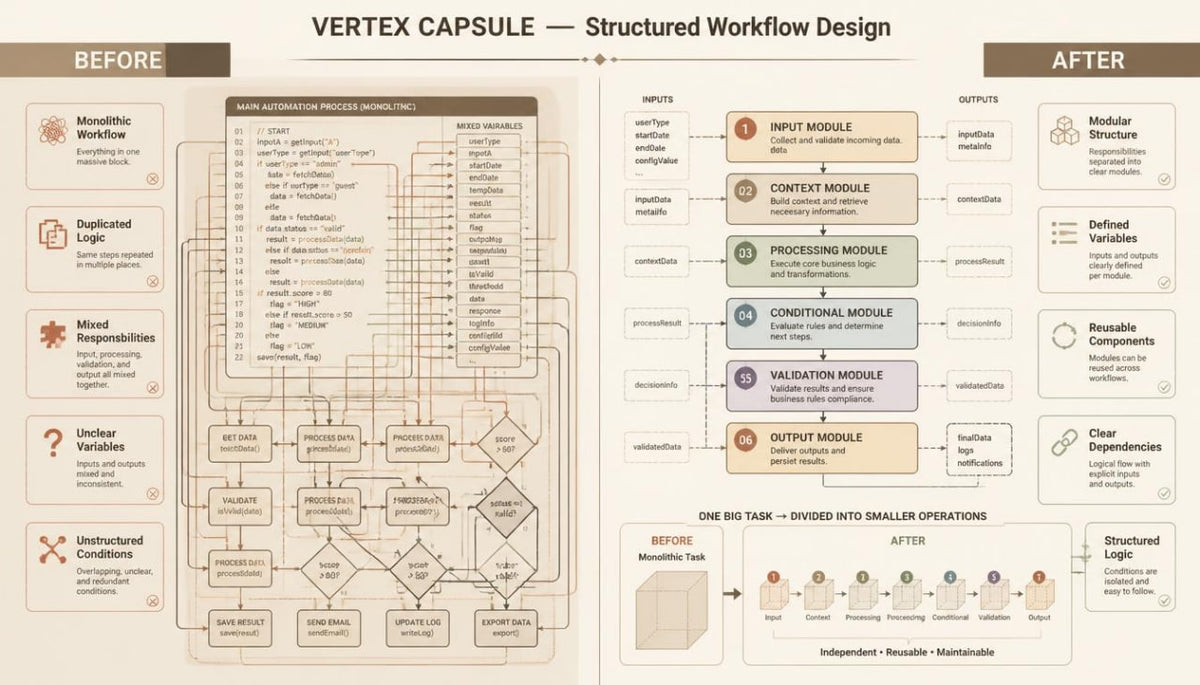
Moving from simple automations to more complex scenarios creates the need to coordinate several operations within one process. Individual stages may use different data sets, have their own execution conditions, and depend on the outcomes of previous actions. When transition logic is not defined in advance, a scenario may contain conflicting rules or unpredictable information-processing routes. Additional complexity arises from incomplete data, repeated operations, and situations in which a stage does not return the expected result. Designing such systems requires a deeper understanding of process structures, component interaction, and methods for evaluating each stage.
2. Solution
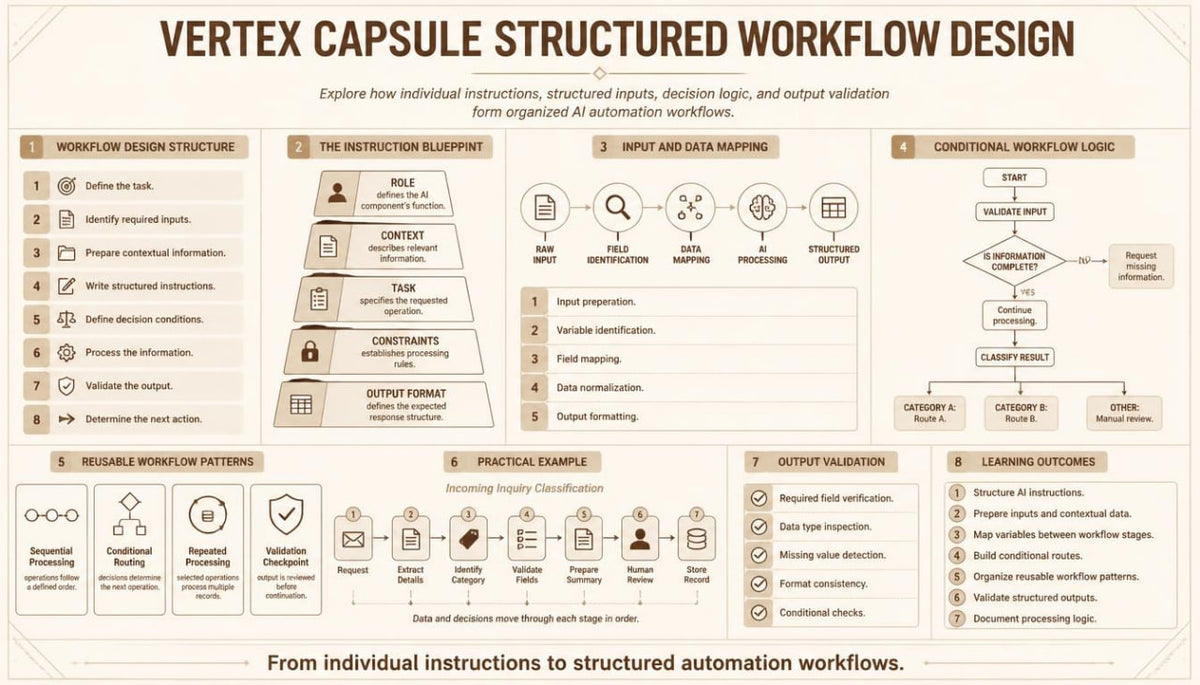
Vertex Capsule introduces methods for designing multi-step automated scenarios and organizing data flows. The learning modules explain how to divide a process into independent components, define their responsibilities, and establish interaction rules. Special attention is given to conditional transitions, branching, data validation, and exception handling. Practical examples demonstrate how to create scenarios with multiple execution routes and reusable components. The final exercises help learners evaluate workflow logic, identify errors, and document the structure of their processes.
3. What's Inside
Module 1: Workflow Architecture and Scope
Study automated process architecture, including its boundaries, components, and functional responsibilities.
Module 2: Data Mapping and Field Types
Explore data structures, field types, value mapping, and information transfer rules between workflow stages.
Module 3: Conditional Branching
Create conditional branches that direct a scenario along an appropriate route according to the received data.
Module 4: Multi-Step Process Design
Design sequences involving multiple operations while defining dependencies and execution order.
Module 5: AI Task Boundaries
Identify tasks suitable for AI components and distinguish their responsibilities from traditional workflow logic.
Module 6: Instruction and Context Structure
Study instruction structure, contextual information, constraints, and expected output formats during AI processing.
Module 7: Reusable Workflow Components
Develop reusable components and organize shared logic for multiple automation scenarios.
Module 8: Validation and Exception Handling
Explore input validation, error handling, missing values, and unexpected processing results.
Module 9: Scenario Testing and Diagnostics
Examine different execution routes, analyze intermediate outputs, and identify the causes of deviations.
Module 10: Workflow Documentation and Review
Create technical documentation, describe dependencies, and evaluate the architecture of multi-step automated processes.
4. Who Is This For?
✅ This course is for you if...
- You are already familiar with the foundational principles of AI automation.
- You want to study the design of multi-step workflows.
- You are interested in conditional transitions and process branching.
- You want to understand data structures and information transfer rules.
- You want to examine how AI components interact with conventional automation logic.
- You plan to create scenarios with reusable components.
- You want to study error analysis and unexpected processing results.
❌ This course may not suit you if...
- You are looking only for an introductory overview of AI automation without detailed workflow structures.
- You need ready-made configurations for specific third-party services.
- You expect complete automated systems instead of educational materials.
- You are interested exclusively in advanced programming of artificial intelligence models.
5. What You'll Learn
After studying the materials, you will be able to:
- Design the structure of multi-step automated processes.
- Define the functional boundaries of individual components.
- Create data flow maps between workflow stages.
- Work with different input value types.
- Develop conditional branches and alternative execution routes.
- Identify dependencies between operations.
- Distinguish AI component tasks from conventional workflow logic.
- Structure instructions and contextual information for AI processing.
- Design reusable scenario components.
- Define information validation rules.
- Analyze errors and unexpected results.
- Evaluate individual execution routes.
- Document automated workflow architecture.
6. Refund Information
Vertex Capsule is a digital educational course. Refund conditions are determined according to the official Refund Policy published by the Drimferiona store. Before placing an order, we recommend reviewing the terms for purchasing digital learning materials and the conditions governing their delivery.
What do Drimferiona courses cover?
What do Drimferiona courses cover?
Our courses focus on AI automation, workflow design, task sequences, and the interaction between individual components. The learning materials combine theoretical explanations, structural diagrams, and practical examples.
Do I need previous experience to study these courses?
Do I need previous experience to study these courses?
No specific technical background is required for the introductory courses. Each course description identifies its learning level and the subjects covered in its modules.
Share